B2ProcessExplainer
Why one kilo of peptide drug can need thousands of kilos of material
Peptide chemistry is famously wasteful. An industry group put the figure for the usual method at around 13,000 kg of input per kg of product.
No single site
This piece is about how peptides are made.
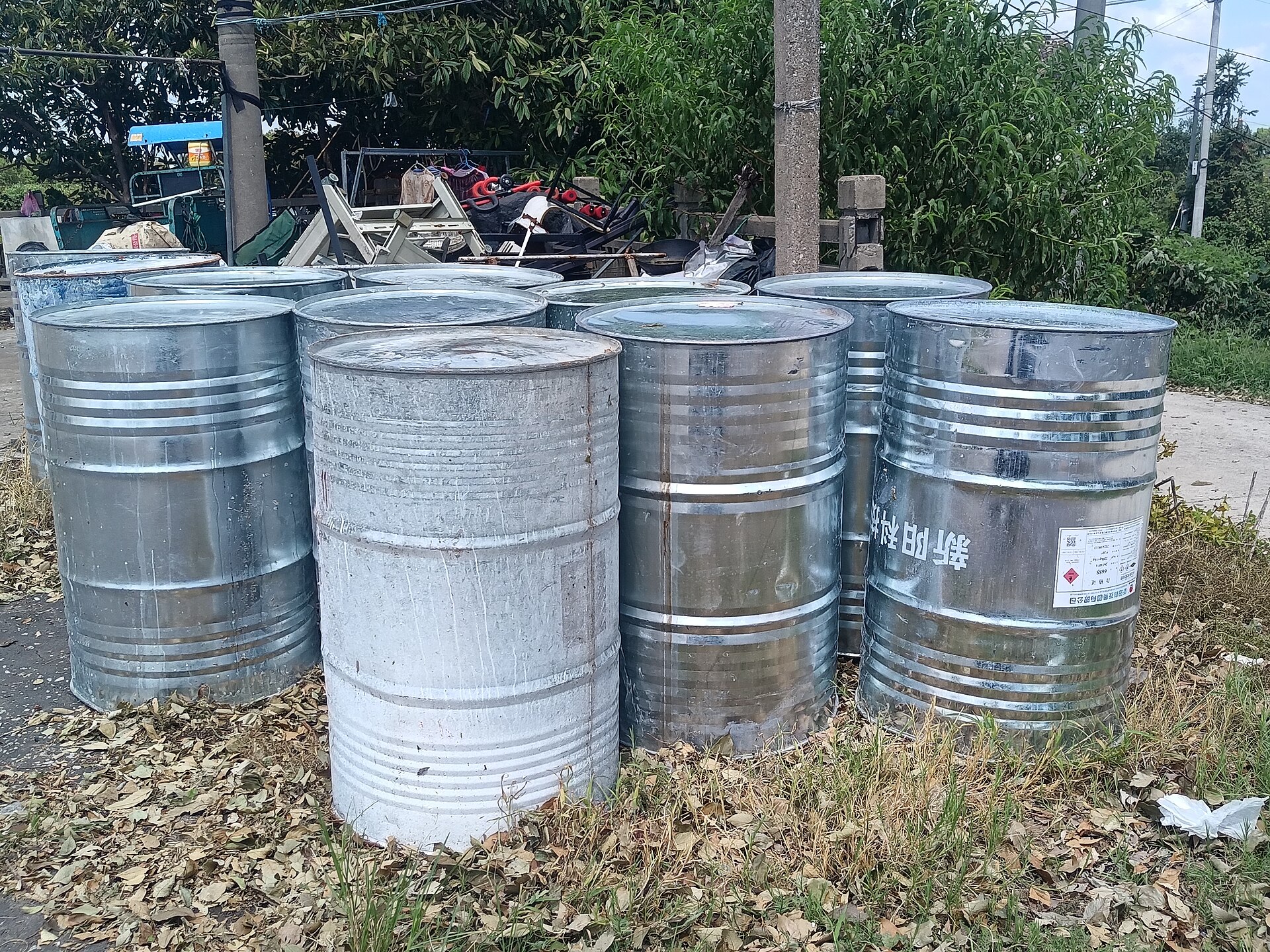
Chemical drums Photo: Fumikas Sagisavas, CC0, via Wikimedia Commons (cropped)
In one lineMost of what goes into a peptide plant is solvent that ends up as waste.
The number
Chemists measure waste with process mass intensity (PMI): kilos of everything used (solvents, reagents, water) per kilo of finished drug. A 2019 review by the ACS Green Chemistry Institute's Pharmaceutical Roundtable put the PMI of solid-phase peptide synthesis at roughly 13,000. Small-molecule drugs are often in the low hundreds.
Where it comes from
In solid-phase synthesis the growing chain is stuck to plastic resin beads. Every amino acid needs a cycle:
- remove a protecting group;
- wash;
- add the next amino acid with a coupling reagent;
- wash again.
A 30-to-40-residue peptide means dozens of cycles, and each wash uses solvents such as DMF. Purification by chromatography then uses large volumes of water and acetonitrile.
What makers are trying
- Greener solvents that replace DMF and NMP, which face limits in Europe.
- Liquid-phase and hybrid synthesis, where fragments are made separately and joined.
- Recycling solvent on site.
- Biological production (yeast or bacteria) for parts of the molecule.
Why readers should care
A plant's footprint, energy use and permits scale with solvent, not with the few kilos of drug it makes.
What it changes for supply
Solvent use sets plant size, cost and how hard it is to get permits. Cutting it is one of the cheapest ways to add capacity.
Still open
How fast greener solvents and liquid-phase methods reach large-scale commercial production.
SourceACS Green Chemistry Institute Pharmaceutical Roundtable, Journal of Organic Chemistry (2019)
Peptide Global covers how medicines are made and traded. Nothing here is medical advice.